In response to growing demand for secure, responsible clinical data sharing across Europe—and the increasing complexity of the evolving regulatory and research environment—Vivli has appointed Jennifer O’Callaghan as Executive Director of Vivli Europe, starting April 16, 2026.
Jennifer will lead the newly established Netherlands-based stichting (foundation), bringing deep expertise in clinical data sharing and the governance of responsible secondary use of clinical research data. Her experience spans roles as a research funder, advisor to multi-stakeholder consortia, and executive within global pharmaceutical organizations.
Leading the European organization, Jennifer will shape strategy and engage partners to enable greater access to high-quality data for researchers across Europe. She will ensure that activities align with the region’s regulatory frameworks and drive initiatives to expand collaboration among industry, academia, and policymakers.
“Europe is at a pivotal moment for clinical research data sharing, and Jennifer brings a rare depth of knowledge in this rapidly evolving field,” said Vivli’s Chief Executive Officer, Rebecca Li. “Strong regional leadership is critical as we accelerate research and expand access to trusted data that can improve patient outcomes. Jennifer’s leadership will be instrumental in advancing Vivli’s mission, scaling impact, and strengthening partnerships across the region.”
Jennifer has been involved with Vivli for over a decade, serving on the foundational working group that established high standards for patient privacy, governance, and transparency while fostering collaboration across pharma, biotech, academia, and the research community to produce new insights.
“At a time of surging demand for data, Europe faces the dual challenge of increasingly complex regulation and the need to balance patient privacy with responsible data innovation, including AI,” said Jennifer O’Callaghan, Executive Director of Vivli Europe. “Vivli Europe will play a central role in meeting this challenge through responsible data sharing in compliance with EU legislation.”
Global research is accelerating, and trusted, compliant data sharing in Europe has never been more complex or essential. To advance collaboration, on March 10, 2026, Vivli expanded its global footprint by establishing Vivli Europe, an independent Netherlands-based Stichting (i.e., Foundation) in Amsterdam.
“Vivli empowers researchers and accelerates medical discoveries through secure, responsible data sharing. Vivli Europe will foster deeper partnerships and create new opportunities for investigators to access and analyze high-quality datasets,” stated Rebecca Li, CEO of Vivli.
Vivli has spent over a decade developing a global network of researchers, data contributors, funders, and institutions to deliver more support for cross-border research. Vivli Europe will continue this trajectory of collaboration and integration.
Establishing Vivli Europe enables alignment with European partners, research, and policy, including the European Health Data Space (EHDS), and engagement in regional initiatives and consortia.
“The establishment of Vivli Europe reflects both the growing importance of cross-border data sharing and the leadership role Europe is playing in shaping its future. Vivli is well positioned to contribute to this evolving landscape by enabling responsible access to data that drives new scientific insights and improves health outcomes worldwide,” said Vivli Board Chair, Steve Kern.
Vivli’s mission remains global, supporting researchers and partners with transparency, integrity, and impact.
The next phase will be announced shortly, discussing the next milestone and initiatives.
Vivli is pleased to announce that Steven E. Kern, PhD, will serve as the new Chair of its Board of Directors succeeding Michael Stebbins. Dr. Kern has been a valued member of Vivli’s Board and brings more than three decades of experience spanning academia, global health, and the pharmaceutical industry.
Dr. Kern most recently served as Executive Director of Global Health Labs, a Gates Ventures initiative focused on developing diagnostic and healthcare technologies for low- and middle-income countries. Prior to that, he was Deputy Director of Quantitative Sciences at the Bill & Melinda Gates Foundation. His academic career included nearly 15 years as Associate Professor of Pharmaceutics, Anesthesiology, and Bioengineering at the University of Utah, where he led clinical pharmacology research across diverse populations ranging from preterm infants to elderly adults.
Dr. Kern has long been an advocate for open, accessible research data and brings deep expertise in data-driven drug development and global health innovation. As Board Chair, he will help guide Vivli’s continued growth as a global leader in clinical research data sharing.
“Steve has been a tremendous asset to Vivli’s Board, and we are delighted that he will now serve as our next Chair,” said Rebecca Li, CEO of Vivli. “His experience across global health, pharmaceutical research, and data science aligns closely with Vivli’s mission. We look forward to working closely with him as we expand access to data and enable new scientific insights worldwide.”
Version 3.9 of the Vivli platform was released February 28th, 2026 and is now available to users. Highlights of the release include:
Updated Organization Administrator Dashboard: Organization Administrators now have an improved dashboard showing Data Requests, Publications, Data Upload, and Enquiries awaiting their action. Dashboard information can also be downloaded.
Multi-Factor Authentication: Multi-factor authentication for user login is being rolled out over the coming weeks. Users will receive an email before this is activated on their account.
Data Request Form Enhancements: Users can now download the data request form, compare different versions of the form as a PDF as part of the version history of a request, and remove a research team member while a request is in draft.
Data Request Summary Report: A new report of the Data Request Summary is available for your team to access at any time.
All Vivli resources and how to guides have been updated to reflect the latest release
“Vivli is delighted to provided additional benefit to our users, which we have prioritized enhancing these features based upon their feedback,” said Julie Wood, COO Vivli. “We would encourage all users to sign up to provide feedback so we can continue to improve the platform to meet their needs”
Researchers can complete the form below to sign up and take part in user interviews.
Note: For the best experience of the Vivli platform and to ensure you are accessing the latest version, please clear your cache in your preferred browser (Firefox, Chrome, Safari, or Edge are all supported). If you experience any problems after clearing your cache, please contact us at support@vivli.org.
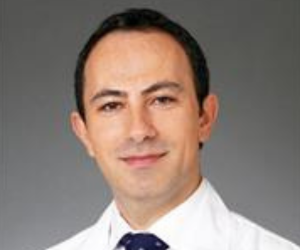
Youssef Zeidan is a radiation oncologist at the Lynn Cancer Center, part of Baptist Health South Florida. Dr. Zeidan was previously an assistant professor of radiation oncology at the American University of Beirut, where he mentored several students who are now working at cancer centers and universities throughout the United States. Dr. Zeidan and his team have authored more than 50 publications related to radiation oncology. He was also part of the committee that developed the 2025 American Society for Radiation Oncology, American Society of Clinical Oncology, and Society of Surgical Oncology guideline on postmastectomy radiation therapy. His contributions to that committee drew upon research conducted with the Vivli platform.
In the extended interview below, Dr. Zeidan discusses how his work with Vivli has influenced both his medical practice and mentorship. Responses have been edited for length and clarity.
I learned about Vivli first from a colleague at a medical conference that I was attending, and it’s been a great journey since then. I’m very thankful for the circumstances. We were at a conference for breast cancer, and they shared with me that I could access clinical trial data through Vivli.
What made you interested in using the platform?
Once I started looking at Vivli, I found it very helpful in asking clinically relevant questions, especially in my domain, which is radiation therapy for breast cancer. Over the past seven years, Vivli has been a great partner in answering key questions in radiation therapy that are relevant to breast cancer patients. We run into situations in treating breast cancer where there are a lot of grey zones, and we don’t have available clinical trial data. Vivli has been a great platform for doing secondary analysis and trying to answer those questions.
Why is Vivli so important for your area of research?
Radiation therapy uses high energy x-rays to treat cancer patients, in my case breast cancer. Vivli has this unique ability to capture data about radiation therapy even though the trials did not specifically ask about the impact of radiation therapy in breast cancer.
For us, it’s a tremendous resource to repurpose and re-analyze those trials for secondary objectives to see the impact of radiation therapy, rather than the drug that the trial is trying to evaluate. In order to do that, we have to do it in a very balanced manner, in a very efficient manner. It takes a tremendous effort from the statisticians, the physicians, the people collecting data, and our partners at Vivli to bring it to an outcome.
How have you used Vivli as a tool for mentorship?
Many of my research team members started as medical students working with me as their advisor. Some of them have now taken faculty positions in very important cancer centers. It’s very rewarding to see the impact of that work, not only in terms of scientific value, but also in terms of the humanitarian value and what happens to the careers of the individuals who are conducting the research.
As a faculty member, I always had students that knocked on my door; they love to be involved in research, love to have projects. The interest is genuine—so to have these students with that drive to answer clinical questions that are out there is huge for us. Having a platform that is willing to partner with us as researchers and help us mentor the younger generation of researchers made the experience even better.
The supervision part was important, but once they get the hang of the Vivli platform and they know how to access the dataset, it really goes by much more effectively and efficiently. It’s a process from accessing the raw data to extracting it, analyzing it, making charts, and then sharing it, whether in terms of presentations or manuscripts. All of these steps from accessing data to analyzing to sharing, whether in terms of a conference or a paper, are different stations and different opportunities for mentoring people who are entering into the medical workforce. For me, looking forward at what those students—and now physicians—are doing and how they’re going to carry that into their own careers and mentor the next generation, it’s really an exponential impact.
You practice medicine, as well as researching. Can you tell us a bit about how continuing to practice medicine affects your perspective as a researcher?
My practice is primarily breast cancer. A lot of the cases that we see are challenging and don’t have a straightforward answer, and we have to scratch our heads to find the optimal treatments according to the best evidence. In doing that process and seeing patients in the clinic, we come up with new questions that we don’t have an answer to every day.
Vivli is an excellent partner and a resource for us to inquire about those questions and find answers through rigorous clinical research and secondary analyses. It really takes a village to come up with answers and clinically meaningful outcomes. I find this exercise of coming up with questions in the clinic, taking them back to the research drawing board, and bringing those answers back to the clinic to be a very fruitful one.
Your research was recently cited in the updated guideline for breast cancer radiation therapy. Could you talk a bit about that?
Recently, the American Society for Radiation Oncology (ASTRO) decided to update their guideline for radiation therapy for breast cancer. The prior guideline was 11 years old. You can imagine how much new data became available, whether from our group or others, during this 11-year period. Fortunately, they recognized this as an area of need.
The part that was assigned to me to lead as part of the committee was actually the part that I had researched using the data provided by Vivli, so it was full circle for me. What we’ve done is to capture data that came up, including secondary analyses from clinical trials—using data like that available from Vivli—and cite that data as evidence for guiding practitioners on how to treat specific types of breast cancer cases with radiation therapy.
Thinking about your patients, is that what you hope the outcome will be? Something like that guideline?
There is not a single case that we see in the clinic that is identical to the prior case. Each case is unique in several aspects. In situations where the quality of the evidence is not very high or there are grey zones where we lack evidence, I share that with my patients. Being focused and specialized in a certain domain really gives you that edge to bring to your patients the latest and greatest research, rather than having them use open, non-resource-verified sources online. Making that step easier on the patients at a time when they have so many things on their plate is very important.
What Vivli is doing on a bigger scale is really impacting healthcare in so many ways, specifically cancer care. I’m grateful for having the opportunity to use Vivli for research, and I think the process made me a better physician for my patients.
“We are delighted to have Novartis join as a member of Vivli, particularly given its rich and long history,” said Rebecca Li, Vivli CEO. “We look forward to working with the team at Novartis to make these data easily available to researchers who want to analyze Novartis data alongside that of other Vivli members.”
For more information about the conditions for accessing Novartis data, please visit their member page. For additional information about membership in Vivli, learn more here.
“We are delighted to have Novo Nordisk join as a member of Vivli, particularly given it’s innovative and life-changing drugs,” said Rebecca Li, Vivli CEO. “We look forward to working with the team at Novo Nordisk to share their data to meet their data sharing commitments.”
Novo Nordisk is committed to sharing information about clinical studies and their results.
For more information about the conditions for accessing Novo Nordisk data, please visit their member page. For additional information about Membership in Vivli, learn more here.
Vivli is seeking an Executive Director for Vivli Europe (Vivli EU Stichting, in formation).
Location: Amsterdam (Netherlands / Hybrid – remote within the EU considered possible for exceptional candidates)
Organization: Vivli EU
Vivli is a global nonprofit platform advancing human health through responsible sharing and reuse of clinical research data. With members across industry, academia, and government, Vivli provides a trusted environment where researchers can discover, request, and analyze data securely. We are now establishing Vivli Europe, a Netherlands-based Stichting that will deepen Vivli’s European partnerships. The Executive Director will lead Vivli EU once formally registered and guide its early growth.
As Executive Director, you will:
Lead the launch and growth of Vivli Europe, ensuring alignment with Vivli’s global mission and strategic vision
Build strategic partnerships with EU institutions, research infrastructures, and funders
Represent Vivli EU in European policy and regulatory dialogues related to data sharing initiatives
Oversee EU operations, governance, and a small Amsterdam-based team
We seek a mission-driven leader who has successfully worked across various EU institutions or consortia and can bridge the worlds of science, policy, and data.
Experience collaborating across academia, government, and industry is essential.
Qualifications:
10+ years leading cross-sector or international research or policy programs
Direct experience engaging with EU institutions or frameworks
Demonstrated grasp of EU health-data policy
Proven ability to build partnerships and manage nonprofit or collaborative operations
Excellent communication and relationship-building skills across diverse stakeholders
Compensation: Salary and benefits aligned with senior nonprofit roles in the EU.
To apply, please submit a cover letter and CV to HR@vivli.org with “EU Director” in the subject line.
This year’s Vivli Annual Meeting was the most well-attended to date—more than 80 people attended in person and more than 150 people attended online to discuss the impact of data sharing via the Vivli platform. Watch the meeting on YouTube.
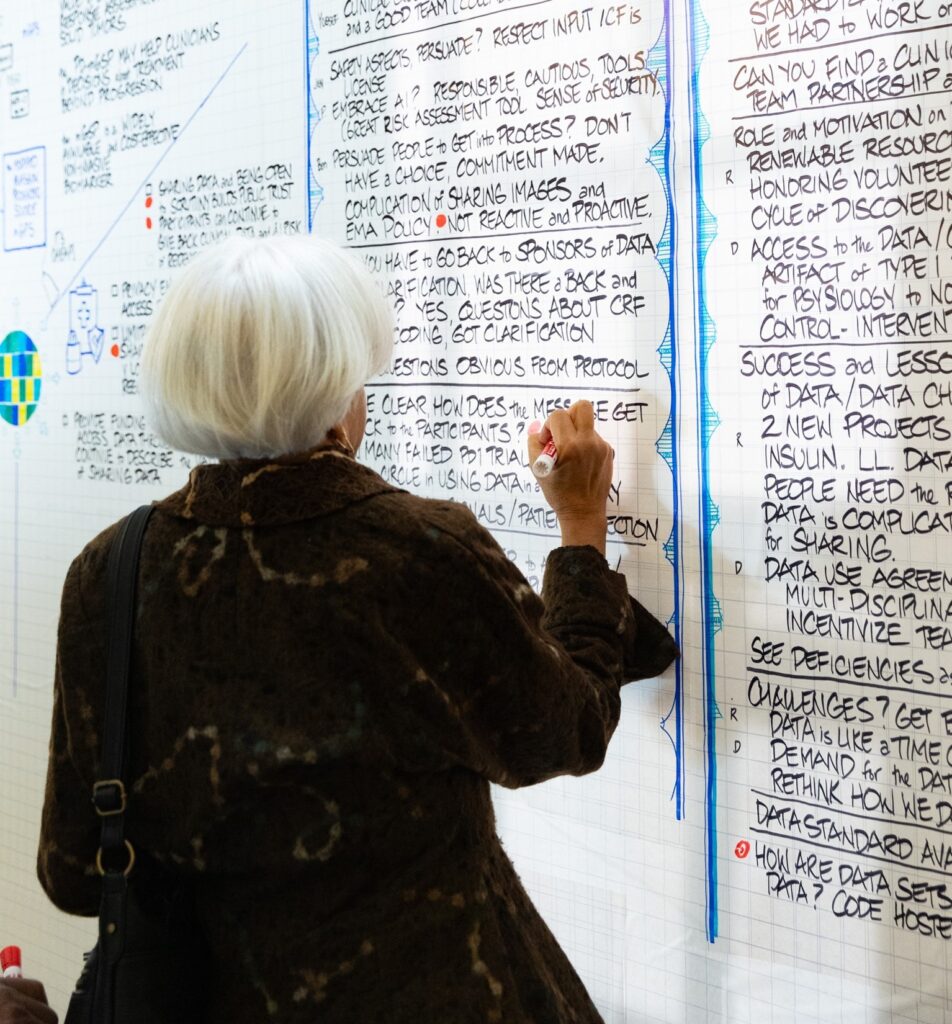
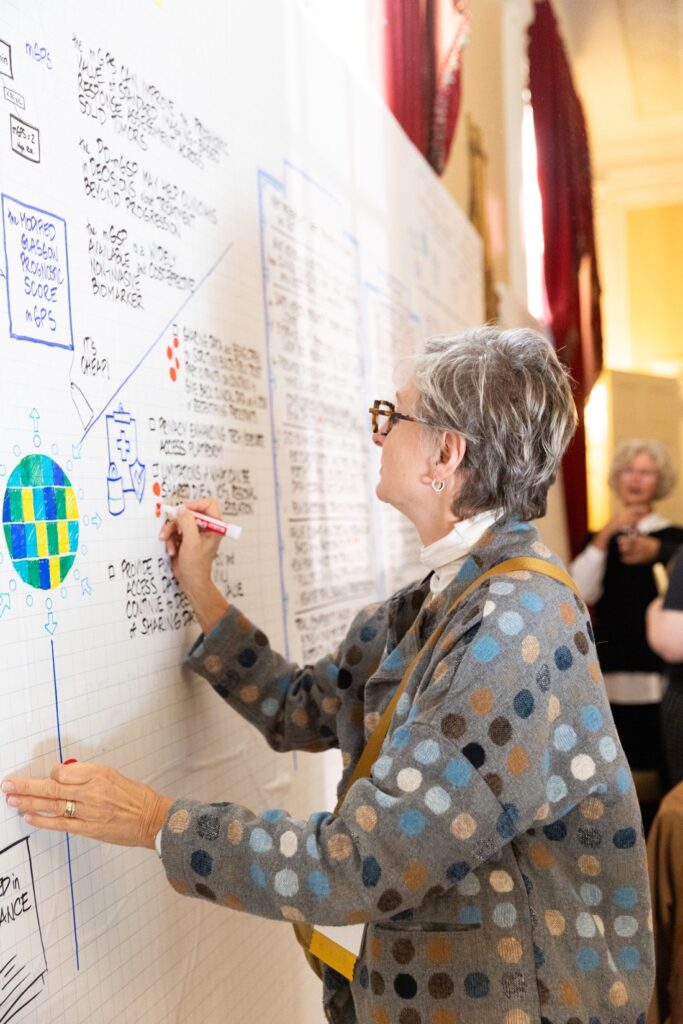
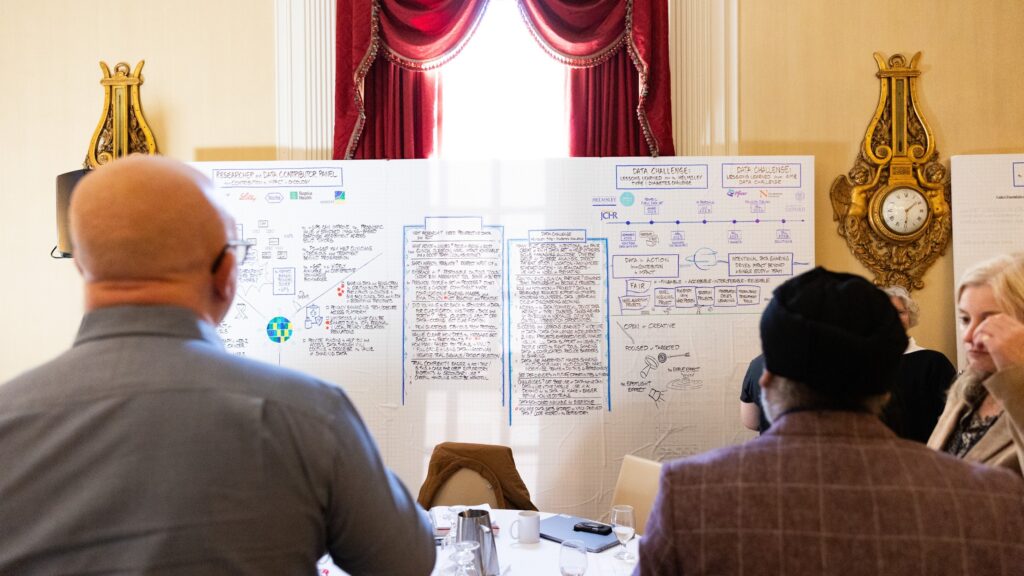
Sarah Greer and Adrian Peryer created a visual representation of the meeting. They produced 9 illustrated boards that highlighted the insights from each panel. During interactive breaks between panels, participants were also invited to share what conversations had captured their interest by marking the boards with red dots.
2025 Vivli Annual Meeting attendees annotating boards with red dots.
The highlights of the afternoon were two sessions on sharing imaging data. Dan Boisvert (Biogen) discussed how a Vivli partnership with Boehringer Ingelheim, Biogen, Pfizer, and Sanofi is taking on the challenges of anonymizing images, such as MRI and x-ray imaging, linking that data with tabular data, and making it available through the platform.
After that, Tim Kinkead (Preva Group) shared how the Gates Foundation is supporting the development of an AI-enabled low-cost ultrasound device, so that pregnant women in low-resource settings can have improved care for the mother and baby. Sharing ultrasound imaging data has been integral to training the device as part of the development process. This will ensure that nearly anyone can use the device to generate an accurate ultrasound.
Vivli will also be sharing additional footage from a fireside chat with the Vivli AMR Data Challenge panelists and insights from our Vivli Ambassadors. Stay tuned for those updates to learn more about how insights from data sharing are shaping clinical practice and changing global responses to AMR.
Thank you to everyone who joined virtually and in person for the 2025 Vivli Annual Meeting.
Version 3.8 of the Vivli platform has been released and is available to users. Highlights of the release for researchers include:
Dedicated publication workflow: There is now a dedicated workflow for researchers to submit public disclosures for review.
Enquiries: Researchers can now submit questions about studies via the platform. They can also ask whether a study is available from a Vivli member if it doesn’t appear in the Vivli search results.
Updated research environment display: The display now provides more detailed information to researchers about their use of the research environment.
Downloadable search results: Researchers can download search results as a .csv file.
All Vivli resources and how to guides have also been updated with the latest release.
“By adding a dedicated workflow for public disclosures, we hope to make it easier for researchers to share outputs from their analyses,” said Julie Wood, Vivli COO. “These enhancements are all based upon feedback from our users. Platform developments are driven by the feedback we receive, so we encourage researchers to reach out to us if they have questions.”
To provide feedback to the Vivli team, please email support@vivli.org. In addition, Vivli regularly conducts user interviews. Researchers can complete this form to sign up to take part in user interviews.

 In response to growing demand for secure, responsible clinical data sharing across Europe—and the increasing complexity of the evolving regulatory and research environment—Vivli has appointed Jennifer O’Callaghan as Executive Director of Vivli Europe, starting April 16, 2026.